



Stock warrants, often simply called warrants, are a common feature in startup financing but are most often encountered in specific contexts. In practice, warrants most frequently appear alongside venture debt, making it especially important for founders to understand how they work and when they are likely to come into play.
At Cake, the majority of warrant deals we see are associated with venture debt deals, which usually occur after a Series A funding round. Occasionally, we see a venture debt deal pre-Series A, but those are the exception.
Used strategically, warrants can help companies close financing deals while preserving cash. When misunderstood or poorly tracked, however, they can introduce unexpected dilution that complicates future fundraising.
This article breaks down how startup warrants work, the key terms to understand, and what founders should watch for when managing them on the cap table.
What is a stock warrant?
A warrant allows the holder to purchase your stock at a set price during an agreed term. In its most common use, it gives a lender the ability to participate in equity upside by allowing them to purchase your stock if you are successful and your stock price increases over time.
Key terms of warrants

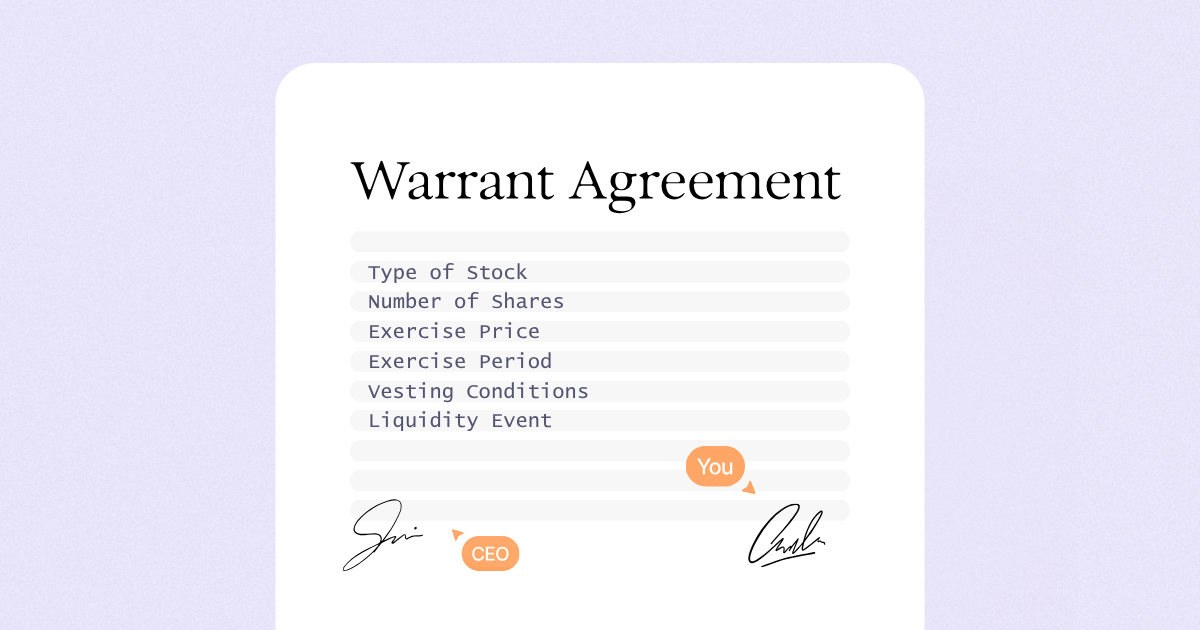
Warrants typically have the following key terms:
- Type of stock. The class of stock the warrant applies to, such as common stock or a specific series of preferred stock.
- Strike price. The price per share the holder must pay to purchase stock under the warrant. This is often tied to fair market value or the most recent preferred stock price and may occasionally be set at a nominal amount in debt-related deals.
- Number of shares. The total number of shares the holder is entitled to purchase, sometimes expressed indirectly through a coverage ratio in venture debt transactions.
- Term or exercise period. The length of time the warrant can be exercised. In venture-backed startups, this is typically between 5-10 years.
- Method of exercise. How the warrant converts into equity. Most warrants are exercised by issuing shares, either through a standard cash exercise or, in some cases, a cashless (net) exercise.
- Treatment in liquidity events. Provisions that define what happens to the warrant in the event of an acquisition, IPO, or similar transaction.
What are stock warrants used for?
In the startup ecosystem, warrants serve specific strategic purposes. Here are common use cases for stock warrants.
1. Venture Debt Structures
Lenders providing growth capital typically receive warrants alongside interest payments. This gives them equity upside while maintaining the debt structure you need for non-dilutive growth capital. For the lender, it's risk mitigation and enhances their returns. They're betting on your growth without relying solely on interest returns. The “value” of options in a venture debt deal is often referred to as the coverage ratio. This refers to the percentage of the loan amount that is given in warrants.
Real-world scenario:
- Company raises $750K in venture debt at 10% interest
- Lender receives warrant coverage of 10% (warrant exercise value (# stock X exercise price) is equivalent to 10% of the loan amount)
- This allows them to purchase 15,000 shares for $75,000 ( $5 per share at the most recent funding round valuation $5M)
- If the company reaches $50M before the warrant expires and the price per share was $35 at the time, they can make a gain of $30 per share or $450,000
- This upside compensates them for early-stage risk and enghances their returns
Typical coverage ratios: 5-15% of loan amount
2. Strategic Partnership Compensation
Partners providing significant non-monetary value receive warrants instead of cash or immediate equity, such as:
- Critical vendor relationships
- Distribution channel providers
- Specialized expertise providers
- Technology or IP licensors
Warrants can align long-term incentives without immediate dilution. This deferred compensation structure keeps your current cap table cleaner while rewarding partners for value creation.
3. Bridge Financing and Convertible Instruments
Early-stage investors taking on higher risk sometimes receive warrants alongside convertible notes or SAFEs. These warrants provide additional compensation for their early bet, particularly in scenarios where conversion terms might not fully reflect their risk.
Stock warrants vs. stock options: key differences
Both instruments grant the right to purchase shares at a predetermined price, but they serve fundamentally different purposes in your equity structure:
Warrants
- Issued to investors, lenders, and strategic partners
- Created and issued directly by the company as standalone instruments
- Dilute all shareholders upon exercise
- Longer timeframes, often 5-10 years
- May be transferable depending on terms
- Part of financing or partnership agreements
Stock options
- Reserved for employees, advisors, and service providers
- Granted under equity compensation plans (typically ESOP)
- Also dilute, but expect as part of compensation strategy
- Shorter windows tied to vesting schedules
- Part of compensation and retention strategy

Track and manage warrants with confidence
Everything you need for warrant management in one platform:
- Dedicated Warrants page in Cap Table for centralized warrant management
- Individual warrant creation or bulk upload for efficiency
- Complete lifecycle tracking (issue, exercise, lapse, duplicate, delete)
- Full integration with diluted cap table calculations and impact modeling
- Overview in MyCake for warrant holders
- Optional vesting schedules that can be applied to warrant grants
- Comprehensive warrant status tracking and reporting
Present confident cap table analysis to investors without second-guessing your numbers.
How stock warrants impact your cap table
Understanding warrant impact on your capitalization structure is essential for accurate modeling and investor communications. Here's what you need to track:
When exercised, warrants trigger the issuance of new shares, creating dilution across all existing shareholders proportionally. The warrant holder pays the exercise price, providing capital to the company, but this cash infusion doesn't offset the full dilution. It's simply the price of the newly issued shares.
Until exercised, warrants exist as contingent dilution on your cap table. Investors will always request your fully diluted capitalization: the ownership structure assuming all convertible instruments (warrants, options, convertible notes, SAFEs) convert to common stock today.
This fully diluted view is what determines true ownership percentages and is critical for term sheet negotiations, valuation discussions, and exit modeling.
When do stock warrants make sense
Warrants are an appropriate tool in specific circumstances:
Use warrants when:
- Structuring venture debt. Where lenders require equity upside beyond interest to justify risk.
- Compensating strategic partners. Where cash isn't changing hands but long-term value alignment is critical.
- Negotiating with suppliers or vendors. Who are taking on significant risk or providing extended payment terms.
Avoid warrants when:
- Compensating employees. Equity compensation plans with options are more appropriate and come with established tax treatment.
- Attempting to avoid dilution. Warrants defer dilution, they don't prevent it. The impact comes when exercised, not when issued.
- Your cap table lacks proper infrastructure. Adding warrants to an already complex or poorly tracked cap table compounds future problems.
- Terms are unclear or rushed. Poorly structured warrant agreements create disputes and complicate future financings.
Best practices for warrant management
Sophisticated founders implement these systems from the start:
1. Centralize your capitalization data
Every warrant, option, convertible note, and SAFE requires systematic documentation in a single source of truth. Version control issues and spreadsheet discrepancies create material errors that surface during diligence.
2. Model fully diluted scenarios continuously
Before agreeing to any warrant terms, model the complete dilution impact. Run scenarios at different valuations and understand how anti-dilution provisions affect various financing outcomes. Your ownership percentage in multiple scenarios should inform your negotiation strategy.
3. Document terms with precision
Warrant agreements should eliminate ambiguity. Clear definitions of exercise prices, expiration dates, adjustment mechanisms, and trigger events prevent disputes and streamline future financings.
4. Implement proper infrastructure early
Once you have multiple stakeholder classes (investors, employees, advisors, warrant holders), spreadsheet-based management becomes a liability. Manual calculations introduce errors, version control becomes impossible, and compliance tracking fails.
Modern cap table management platforms automate calculation accuracy, maintain complete audit trails, and handle complex scenarios like exercise modeling and waterfall analysis.
This isn't about tools for the sake of tools—it's about building systems that scale with your complexity. Cake Equity is designed specifically for this: maintaining precision as your cap table grows from simple to sophisticated.
5. Update systematically
Every issuance, exercise, or financing event should trigger an immediate cap table update. Consistent maintenance prevents the accumulation of errors that become expensive to unwind during time-sensitive transactions.
Explore Cake Equity and see how proper infrastructure transforms warrant management from a compliance burden into a strategic advantage.
Your frequently asked questions on warrants, answered
How long do stock warrants last?
Typically 5-10 years, but it varies by agreement. The expiration date is set when the warrant is issued, and if the holder doesn't exercise by that date, the warrant expires worthless.
Can stock warrants expire?
Yes. Unlike shares, warrants have expiration dates. If not exercised within the specified timeframe, they become void.
What happens to warrants during an acquisition?
This depends on the warrant agreement and acquisition terms. Often they're either exercised before the acquisition closes, or they're bought out as part of the deal. Always check your warrant agreements for change-of-control provisions.
This article is designed and intended to provide general information in summary form on general topics. The material may not apply to all jurisdictions. The contents do not constitute legal, financial or tax advice. The contents is not intended to be a substitute for such advice and should not be relied upon as such. If you would like to chat with a lawyer, please get in touch and we can introduce you to one of our very friendly legal partners.