



- A stock option gives an employee the right, but not the obligation, to buy a set number of company shares later at a price fixed today, regardless of what the shares are worth by then.
- Your strike price is set by a 409A valuation and rises as your company's valuation grows, so setting up your ESOP before key hires join locks in a lower price for them.
- ISOs are only available to employees and get better tax treatment, but any grant that exceeds $100K in vesting value in a single year gets automatically split into ISO and NSO portions.
- Exercising ISOs can trigger the Alternative Minimum Tax even though it avoids ordinary income tax, so option holders exercising a large grant typically check with a tax advisor first.
- Every option granted dilutes existing shareholders, so most founders set a maximum pool size before making any offers.
Startup stock is like a slice of cake: you want to be the first one to get a piece while it's fresh from the oven, and before everybody else gets their own share! That's where startup stock options come in: they let early startup employees claim their slice of the cake before everyone else does.
Equity sharing in later-stage companies involves more complexity, as more layers and tiers get added to the metaphorical cake. This guide covers the foundations of startup stock options, specifically for early-stage startups where employee equity is every founder's not-so-secret ingredient.
Michael Houck, ex-Airbnb and ex-Ubereats, now co-Founder of House Capital, believes in the importance of startup employee equity. He says,
"Employee equity is super important. You want to make sure that employees, especially early employees who are making a huge commitment and taking a huge risk to bet on your startup versus one of the many of the other things they could do with their skills, are compensated for that and have the upside for that in the long run."
Whether you're a startup founder looking to create an employee stock option plan, or an employee looking to join a new startup and trying to understand the equity compensation you were just offered, allow us to help you in your journey!
In this article, we tackle:
- What are startup stock options
- Why do startups use stock options
- What are the types of startup stock options
- How do stock options work in startups
- When is the right time to set up a stock option plan
- Frequently asked questions on startup stock options
What are startup stock options
Startup stock options are a form of equity compensation that startup founders offer to their employees. In essence, they are an agreement between the employer and employee that gives the latter the right, but not the obligation, to buy company shares in the future at a pre-set purchase price. That price, known as the strike price, is typically set at the company's fair market value as determined by a 409A valuation, not a number the founder picks arbitrarily.
What stock options are NOT, then, is a guarantee of financial gain. If the startup doesn't do well, or if it is sold before the options can be exercised, then the employee walks away with nothing. On the upside, if the startup does well, those employees who know how to exercise their options can gain significant financial returns from their investment into the company.
Remember this because it's important to understand both the gains and the risks before taking advantage of stock option plans.
Why do startups use stock options
Simply put, a stock option grant is a way for companies to effectively establish its pioneer team of employees by offering them equity in the business. The idea behind offering stock option grants is to attract top talent by providing them with an incentive: a potential financial gain if they stay with the company and contribute positively to the company's growth.
Stock options are essentially shares of company's stock given to employees at a discounted price (what we typically call "exercise price" or strike price"), usually below what they would pay on the open market. When an employee buys these stocks at a lower price, it gives them more upside potential if the company does well over time.
Attracting, motivating, and retaining talent
For your employees, considering stock options means they are getting a piece of the company they work for rather than just a pay check. This can be extremely attractive to people who want to invest in their future and the success of your business. Plus, it helps attract employees that may not have come to you otherwise.
Houck adds,
"You want to make sure that everyone's bought into the future vision of the company. And as a founder, you want to make sure that people are going to be in it for the long haul and stick around, and are in it for something more than just a pay check."
Jason Atkins, co-founder of Cake Equity, believes that employee stock options enable you to attract and retain the best kind of employees who will grow with the company,
"The best people are attracted by having some skin in the game so you're gonna have a better quality team from the starting point. They're gonna be more engaged. And then there's also the retention element, especially in the first few years when you're finding product market fit and your brand's growing and your product's improving. So much of the IP is within those people's brains and the networks that they build. So you really want to keep them."
How would you pitch this to prospective employees, then? You could tell them that if they join your startup, not only will they get to be a part of something unique and exciting, but they also have the potential to gain equity in the company. If the stock does well, so do their holdings! This motivates them to invest in themselves and their future while being a part of your team.
Engaging and enlisting the help of advisors
Engaging with startup advisors is also beneficial particularly in the early stages where guidance from experienced experts are required.
Startup advisors already understand the value of stock options and often prefer them over straight equity or cash compensations. They like it because they get to have a stake in the company in exchange for their knowledge and experience, without even working in the business full-time.
Advisor shares is also a form of stock option grant and typically fall in the same stock option pool.
Read more about advisor shares here.

Manage your stock option plan with ease
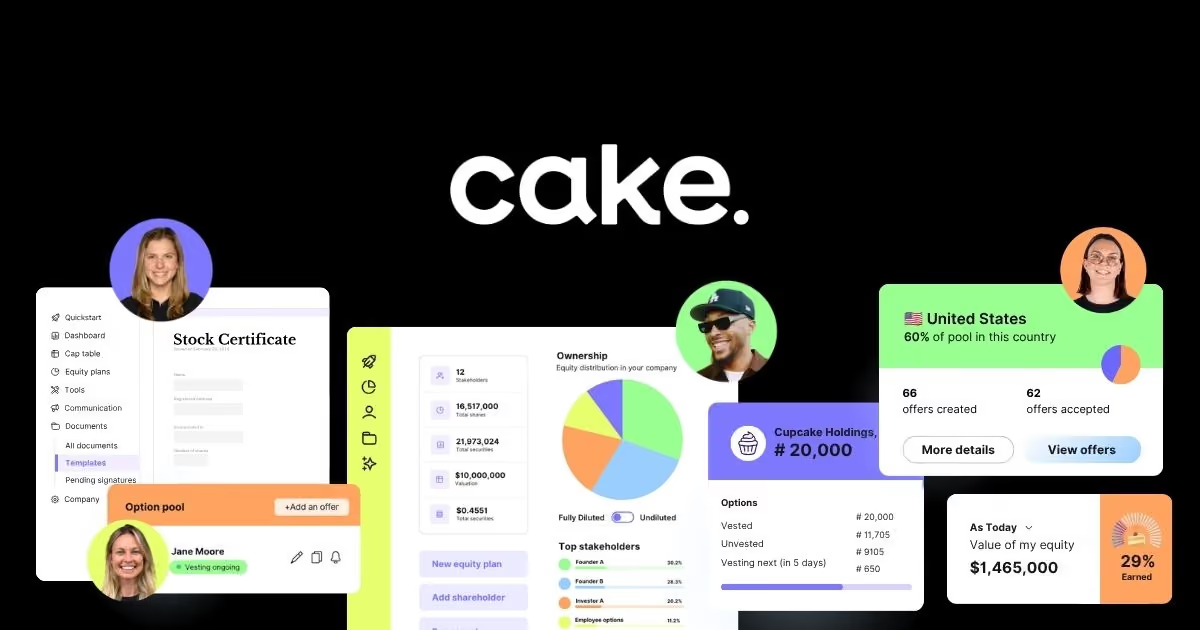
Cake replaces the manual grant-and-signature process with a single digital workflow, from setting up your option pool to tracking vesting once options are live. With Cake, you can:
- Create an option pool and grant terms without starting from a legal template
- Send grants for digital signing, with optional company countersign before employees receive them
- Classify ISO and NSO automatically, including splitting any grant that crosses the $100K ISO limit
- Get automatic vesting and expiry notifications, so nobody has to chase status by hand
"We're trying to issue options out to 150 people every year. Trying to get people's signatures and just all of the admin around that: who's signed, who hasn't signed, trying to keep track. With Cake, all that confusion is a thing of the past."
— Gavin B, Founder & CEO
See how Cake handles your stock options works.
What are the common types of stock options
The two most common employee stock options are incentive stock options (ISO) and non-qualified stock options (NSO).
Incentive stock options or ISO
Incentive stock options are granted only to employees, and they come with more favorable tax treatment than other option types. Exercising ISOs doesn't trigger ordinary income tax the way NSOs do, and any eventual gain is typically taxed at the lower long-term capital gains rate if specific holding periods are met. ISOs can trigger the Alternative Minimum Tax (AMT) on exercise, though, so option holders exercising a meaningful number of ISOs typically check with a tax advisor first. Read more about ISO tax treatment and AMT.
Non-qualified stock options or NSO
Non-qualified stock options, on the other hand, are available for anyone who works at a company, not just employees; they do not qualify for favorable tax treatment like ISOs do. With NSOs, you may have to pay taxes immediately upon exercising your option, as the gains from NSOs are considered income. However, NSOs still offer the potential for significant profits in the future if the stock price goes up.
Know more about the difference between ISO vs NSO.
RSU, SAR, ESPP
There are other types of equity grants, which are more common in more matured and later-stage companies.
- Restricted Stock Units (RSU)
- Stock Appreciation Rights (SAR)
- Employee Stock Purchase Plans (ESPP)
However, for the early stages, the most common ones are stock options (NSO and ISO).
How do stock options work
Here's what typically happens when setting up employee stock option plans:
Deciding on the number of shares you like to offer
As a startup founder, you need to decide on the number of shares you'd like to offer to the employee. This can be done by calculating the dollar value at which each share will be sold and then dividing that number by the price per share of your company's stock. From there, you can determine how many shares you would like to offer. Know more about how much options to offer startup employees.
Signing the startup stock option agreement
An employee receives a stock option agreement that outlines the rights of both employee and employer about their stock options, including any vesting conditions or expiration dates associated with them. An employee usually receives an Offer Letter to start, and then a more detailed document or Plan Rules that should be signed by both parties.
Stock option agreements are legal documents that typically contain the following information:
- Total number of shares granted
- Type of options
- Exercise price per share
- Grant date
- Vesting schedule
- Termination period
- Term of award/expiration date
- Administration and exercise of option
- ..and other legalese on non-transferability of options, tax obligations, change in control, governing laws, etc.
Waiting for your stock to vest
A stock option holder is not able to exercise options until those options have vested. And until the option is exercised, the option holder does not have stockholder rights. Which means until options have vested, the option holder don't gain full rights to their slice of the cake.
The purpose of vesting schedule is to tie some obligation of performance (or time) to the options. It’s why employee stock option plans are such a powerful tool for incentivising your team to stay longer (and work smarter) towards the ultimate success of the company.
Know more about stock vesting.
Exercising your options
Finally, when it comes time for your employees to exercise their options, they will do so through a brokerage account that is connected to your company's records. The proceeds from this sale are then split between the employee and the company based on whatever rate was agreed upon in the stock option agreement.
It's important to have an exit strategy in place so that everyone knows what will happen if the startup sells or goes public before all of the stock options are fully vested. It's also important for both parties (you and your employees) to understand their respective rights when it comes to selling, transferring, or exercising their options.
Taxation
When it comes to taxes, stock options can be taxed as either ordinary income or capital gains, depending on the type of option and how long it's held. Generally speaking, you'll want to make sure that both parties understand any tax implications associated with the stock option agreement before signing off on it.
Overall, understanding how startup stock options work can help ensure that everyone involved is fully informed when making decisions about equity in your company. All parties need to understand the risks and rewards before agreeing to any terms so that there are no surprises down the line!
When is the right time to set up an employee stock option plan
The right time to set up an ESOP is early, ideally before your first key hires join. Waiting until later means new employees join at a higher strike price with less upside, since the strike price rises alongside your company's valuation. Having stock options in place from an early stage also helps attract and retain talent while incentivizing employees to focus on long-term success.
Setting up early benefits both the founder, in attracting and retaining talent, and the employee, since they hold a share of the company's stock while the exercise price is still low. While ESOPs still exist in later-stage startups, early employees generally get a lower exercise price. As the fair market value of the stock rises, that exercise price becomes increasingly expensive.
What we commonly see: founders set a maximum pool size upfront to control dilution before any offers go out. Setting up an ESOP also requires legal advice for everyone involved, including employees, advisors, founders, and investors.
More FAQs on startup stock options
How many stock options should I offer as a founder?
Most founders start by setting aside an option pool as a percentage of fully diluted shares, then grant individual amounts based on role, seniority, and how early someone joins. How much options to offer startup employees walks through the calculation in more detail.
What are the advantages of offering stock options to my team?
Stock options let you compensate employees with upside instead of just cash, which matters most when your startup can't yet pay top-of-market salaries. They also give employees a reason to stay and contribute past the initial excitement of joining, since most of the value comes from vesting over time.
What are the risks of offering stock options as a founder?
Every option you grant dilutes existing shareholders, including you, so pool size needs planning before offers go out. There's also an expectation risk: if the company doesn't grow in value, employees who joined partly for the equity upside may be disappointed, even though the options themselves cost the company nothing until exercised.
Should I grant ISOs or NSOs to my team?
ISOs are only available to employees and come with better tax treatment, so they're the default choice for full-time hires. NSOs work for anyone, including contractors, advisors, and board members, which makes them the right fit whenever you're granting equity outside your employee base. ISO vs NSO covers the tax differences in more detail.
When should I set up my company's stock option plan?
Most founders set up their ESOP early, before their first key hires join, since the strike price only gets more expensive as the company's valuation grows. How to set up a stock option plan for a seed-stage company covers the setup steps.
This article is designed and intended to provide general information in summary form on general topics. The material may not apply to all jurisdictions. The contents do not constitute legal, financial or tax advice. The contents is not intended to be a substitute for such advice and should not be relied upon as such. If you would like to chat with a lawyer, please get in touch and we can introduce you to one of our very friendly legal partners.