









- The best cap table software is easy to use. It has the right features for your stage. It grows with you, from seed ownership tracking to scenario modeling and investor reporting as you scale.
- Cake Equity is rated 4.8/5 on G2 and built for growing startups — particularly teams scaling headcount and managing equity across employees, advisors, and investors.
- Carta has a quote-based pricing that startup founders find too costly. Startups switching from Carta to Cake have saved between $3,000 and $16,000 per year.
- Pulley is a strong option for early-stage YC founders. Ledgy is great for EU-based or globally distributed teams. Shareworks is designed for late-stage and public companies.
- When you review any platform, consider fast onboarding, transparent pricing, customer support, data security, and features that you will need for your next stage of growth.
Cap table software comparison
How the top cap table platforms compare on features, pricing, and fit.
Cake is designed for startups with growing teams and active fundraising, where equity is a core tool for attracting talent and closing rounds.
See why users love Cake, sign up today. Switching? Migration is free.
If you're looking for a cap table software, you're likely in one of these two situations.
You've outgrown the spreadsheet. An investor or attorney is asking for a clean cap table, and your last update was three months ago. The formulas are questionable. The version history is a graveyard.
Or you're already on a platform, and you just opened a renewal invoice that made you do a double take. You're paying enterprise prices for features you don't use, on a tool your team barely opens.
You want a living and breathing cap table that grows with you and moves your team to action—at any given stage, for every given milestone. As Ellen Dinsmoor, COO at Vow, once said, "A source of truth that you actually use on a day-to-day basis" as it informs important operational decisions.
Both roads lead to the same question: what's the best cap table software for a scaling startup that wants to get equity management right, and at the right price?
What is a cap table software?
Cap table software records who owns what in a company and how that ownership changes over time through funding rounds, equity grants, and other transactions. A cap table software automates this tracking, replacing manual spreadsheets with real-time calculations, compliance tools, and stakeholder reporting.
Cap table software and equity management software are not necessarily the same thing. Cap table management focuses on ownership tracking and dilution modeling. Equity management software is broader, adding different types of equity incentives such as employee equity plans (stock options, RSUs), 409A valuations, and compliance tools. Many platforms, including Cake, offer both under one roof.
When spreadsheets stop working
We're not against spreadsheets. If you're comfortable with formulas, you can get a long way with cap table modeling in Excel or Sheets, and Cake lets you export your cap table to CSV any time you need it for something else.
The problem isn't the spreadsheet, it's what happens once equity gets more complex. It works fine when ownership is simple. It becomes a liability once you have employees on vesting schedules, investors on your cap table, and a funding round to model.
You need a software built for where you're going, not just where you are.
— Nick Cust, CPO AT Cake Equity
A single formula error can misstate ownership by several percentage points, and that kind of mistake tends to surface at the worst possible moment, right when an investor asks for a clean, auditable cap table.
The tipping points are consistent: you start issuing equity with vesting, you take on SAFEs with different valuation caps, you're preparing for a priced round and need to model dilution, or an investor asks for a cap table your spreadsheet can't produce. If any of that sounds familiar, it's probably time.
When do you need a cap table software?
The best cap table management software is designed not only for managing capital, but for equity management. You know you need a cap table software when you're starting to think about:
- Issuing employee equity grants and tracking ownership
- Managing equity holder information like contact details and vesting schedules
- Modeling dilution and scenario planning for funding rounds
- Providing audit trails and keeping historical record for compliance
Cap table and equity management can become complex and expensive quite quickly, especially when you factor in legal fees. Investing in a reliable cap table software can be a lifesaver at a time when you need your energy and resources growing your business.
What to look for in a cap table software?
The right cap table software depends on your stage. A few things are non-negotiable.
1. Onboarding and migration support
When selecting a cap table platform, choose one that enables quick implementation. Look for solutions that let you import existing data (spreadsheets, SAFEs, share classes) and become operational within a few days. If it takes over a week just setting it up (and no one available to help!), it might indicate potential admin issues down the road.
The best cap table management tools offer guided setup processes and automation features that minimize manual data entry. Having migration support is also a good indicator of the kind of customer support available for you.
2. Ease of use
Evaluate how intuitive the platform feels for all stakeholders. Startups want to spend less time on admin work and more time focusing on growth. Effective capitalization table provides a clean, straightforward dashboard that stakeholders can navigate without specialized training.
Consider whether the platform offers helpful features like simplified workflows, streamlined grant creation, and clear visualizations of equity ownership and dilution, among others.
3. Equity management tools
Look for a cap table software that can efficiently handle equity compensation, ownership structure, vesting schedules, equity grants, and share/option holder information.
Plus points for a separate employee experience that removes the fluff and gives team members what they need to visualize and track their equity compensation.
4. Fundraising and scenario modeling tools
Consider how the platform supports, not only your ownership structure but also your fundraising activities. An effective cap table software should enable pre-money/post-money modeling, SAFE and convertible note conversion calculations, option pool adjustments, among other things.
As you grow, you find that you need more advanced features like exit scenario planning. It helps to determine what fundraising and cap table modeling tools you need depending on your growth stage.
5. Security, data control, and compliance
Examine the platform's security and compliance features. Your cap table solution should provide strong encryption, customizable access controls based on user roles, and compliance tools that support 409A valuations and other relevant regulations.
Ensure also that you maintain ownership of your data with full export capabilities to avoid vendor dependency.
6. Affordability and pricing transparency
Review the pricing structure. Choose platforms with clearly defined costs, no hidden fees for adding shareholders or issuing grants, and the ability to scale with your company's growth. Be cautious of vendors that require expensive early upgrades or restrict essential features behind premium tiers.
7. Quality of support
Evaluate the available support resources. Quality support becomes particularly valuable when navigating equity management for the first time or handling complex scenarios.
Effective platforms offer responsive customer assistance through channels like live chat or email, alongside comprehensive self-service materials including templates, video tutorials, and documentation.
Power tip: One quick look at review sites like G2 gives you a picture of the cap table features and/or support available for you. Read customer reviews and testimonials when evaluating cap table platforms. Check out Cake Equity on G2.
Carta alternatives
While Carta maintains a dominant position in the cap table market, it can also become too complex and too costly for startups. One of the most common concerns we hear about Carta is the surprise price increases and lackluster customer support.
Carta is also often perceived as the platform with more features for later-stage companies. But this often means users are paying for more "bells and whistles" than they actually need.
"Carta has a lot of bells and whistles but I didn't actually really need any of them. I want something that's easy to use and great for my investors and my employees."
— Lauren Humphrey, Co-founder & CEO at The Mintable
The cap table industry continues to evolve and grow, with features that are more attuned to the actual needs (and budgets) of scaling startups.
By carefully assessing your company's requirements and growth trajectory, you can select a platform that delivers the necessary functionality without unnecessary costs or complexity.

The cap table software that grows with you
Most cap table platforms stop at admin: a system of record the finance team opens and everyone else ignores. Cake gives every stakeholder, employee or investor, their own real-time view of what their equity is actually worth.
- Robust cap table features for every stage of growth
- Scenario modeling, SAFEs, Convertible Notes, Warrants, and capital raising tools you need as you scale
- Compliance reporting integrated into your cap table
- Contract signing and a source of truth for all of your grants and share certificates
- Employee and investor portal to track vesting and holdings in real time
Know more about Cake's cap table.
Best cap table software for growing startups
We reviewed the top cap table platforms based on features, pricing, verified user reviews, and how well each serves from various growth stages.
.svg)
1. Cake Equity — best overall for scaling startups
We take pride in designing a cap table management software that is founder-focused and employee-friendly. At its core, Cake Equity is driven by a mission to help startups turn their cap tables into a powerful tool to accelerate team motivation through meaningful equity ownership.
This mission fuels Cake's feature set and even its pricing tiers. It offers an intuitive user interface that helps ambitious founders hit the ground running without a steep learning curve or implementation overhead; transparent pricing tied to where you are in your growth journey; and a unique investor/employee experience that highlights equity education and team motivation.
Main features:
- Fast onboarding and free migration. Get a clean cap table up and running within minutes; or if you have an existing cap table somewhere, get your cap table data migrated within 2-3 days
- User-friendly interface that simplifies complex equity concepts
- Clean visualization tools that make ownership structure easy to understand
- Equity management, digital signing, vesting notifications, and automated workflows
- Support for different types of equity grants (stock options, common or preferred stock, restricted stock, etc.)
- Built-in term sheet, SAFEs, and convertible agreement templates
- Add-on compliance and valuation reports as needed
- Employee and investor portal with equity education resource, tracking and visualization, and communication portal
Ideal for:
- US-based startups, particularly founders scaling their team, preparing for a funding round, or moving off a legacy platform like Carta.
- Strong focus in the US, with a team based in Los Angeles, CA, and a US-based network of accounting, finance, legal, and community partners
Pricing:
- Cake is FREE for up to 5 stakeholders.
- Build plan begins at $1,000/year for up to 25 stakeholders, inclusive of cap table features, SAFEs and convertible notes, scenario modeling, shareholder vesting and 83B, employee/investor app, and attorney network integration—everything a startup needs as it raises its next round and grows its team.
- Team plan starts at $2,750/year for up to 40 stakeholders, or if you want to add features like incentive plans, board approvals, 409A valuations kept up to date, RSUs, and a contract editor your attorney can work with. Team billing is annual only.
- Pro plans are available for companies that require advanced reporting and compliance features like ASC 718, form 3921. Get in touch for custom pricing.
Highly recommended by users
Cake Equity is the top-rated equity management platform on G2, ranking #1 in Implementation, Usability, Results, Momentum, and Relationship as rated by startup founders, investors, and attorneys.
What I hear most from founders who switch to Cake is that it's simpler than expected. Not fewer features, just features that work intuitively for every stage of growth.
Lemonlight saved $3,000 a year after switching from Carta:
"We were paying a premium for Carta without really using the platform much. It felt like an expensive, oversized solution for what we actually need."
— Hope Horner, Co-founder and CEO for Lemonlight
Vaporox cut equity management costs by 40%, down from a $16,000 annual Carta bill, and migrated in two weeks.
"The cost was just not making any sense for us. You guys were able to offer something that was affordable for us."
— Jana Gendron, Supply Chain Controller at Vaporox
Tom Hakel of CXO Strategies, was a Carta user for 12 years before a community of Silicon Valley startups recommended Cake:
"The delightful surprise was it was a better product. We saved money with a better product."
— Tom Hakel, Founder & CFO at CXO Strategies
Read more founder success stories here.
2. Pulley
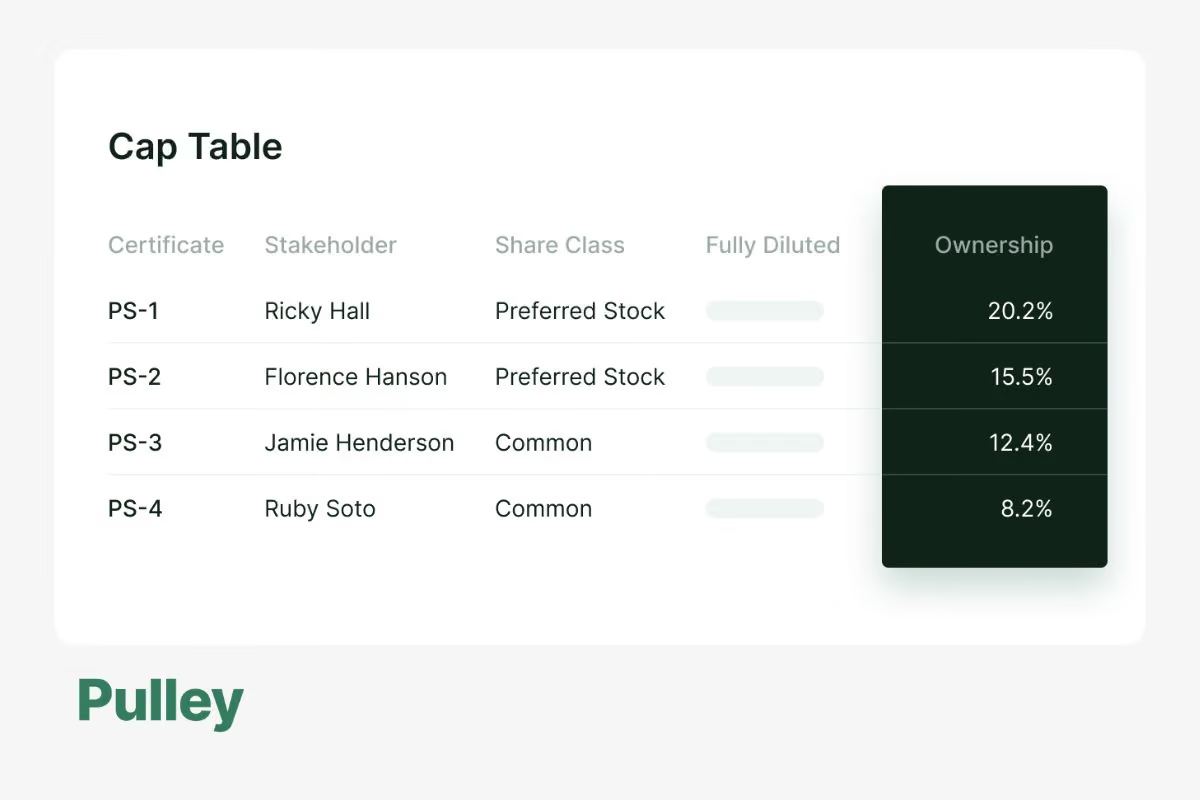
Pulley caters to early stage companies, particularly in the YC ecosystem. Pulley's main features are its fundraising and modeling tools, SAFEs, and audit-compliant 409A valuations. Like Cake, it supports equity plans with its built-in equity calculators, offer letters, and vesting customizations.
Based on G2 data, Pulley's user base skews toward small businesses rather than companies with growing teams. If your cap table is straightforward and you're staying domestic, it covers the essentials. If you're preparing for a Series A or managing equity across a distributed team, you'll likely hit its ceiling.
Pricing:
- Startup plan starts at $1200/year, inclusive of cap table and equity management tools, up to 25 stakeholders
- Growth plan jumps up at $3600/year for 40 stakeholders, inclusive of 409A, 701, and 3921
See how Cake compares: Cake vs. Pulley
3. Ledgy
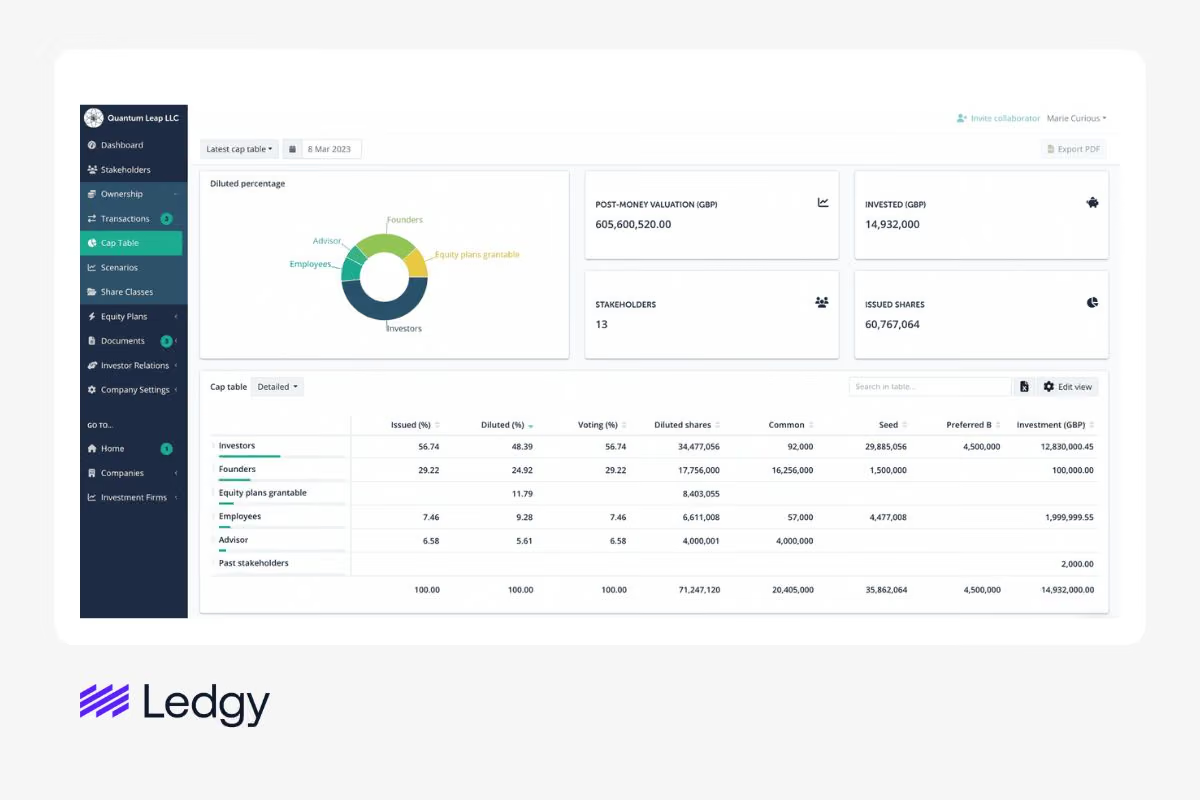
Ledgy was built to solve equity management challenges for European startups, with particular focus on cross-border compliance and multi-country teams. Their mission centers on making equity accessible across different regulatory environments.
Ledgy specializes on features that cater to EU and global companies, global equity programs, and country-specific compliance for EU jurisdictions. They also cater to US markets, so if you're a US-based company with EU-based teams, Ledgy might be worth considering.
Pricing
- Growth Plan starts at €900/year, inclusive of basic cap table and equity management tools
- Scale Plan starts at €3k/year, if you need additional compliance and valuation reports
4. Shareworks by Morgan Stanley
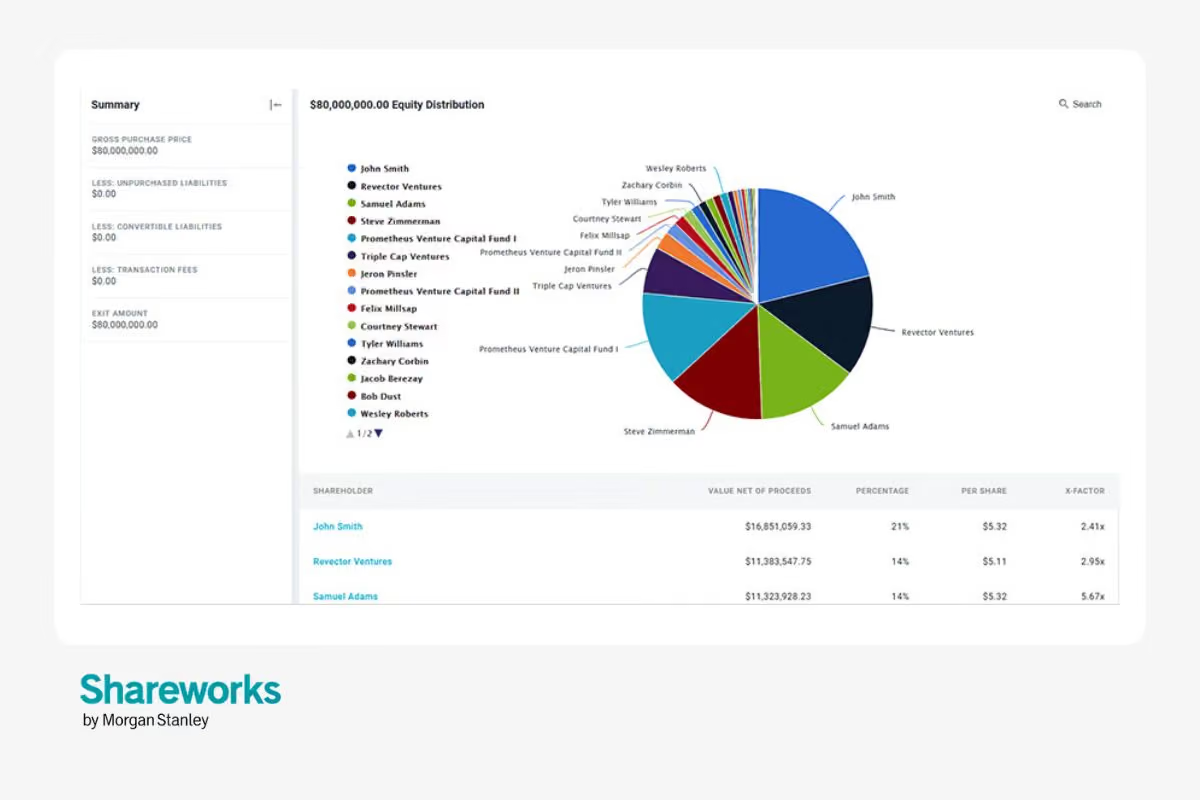
As part of Morgan Stanley, Shareworks focuses on providing institutional-grade equity plan management. Their mission emphasizes preparing companies for significant liquidity events while maintaining compliance across complex organizational structures.
Shareworks is best for IPO-ready companies with multi-entity corporate structures and global equity programs.
Pricing: Enterprise-level, pricing available on request.
Your questions on cap table software, answered
What's a good Carta alternative for an early-stage startup?
If you're an early-stage startup outgrowing spreadsheets, look for a Carta alternative built for your stage. Cake Equity is free for up to 5 stakeholders, with paid plans starting at $1,000/year, well below Carta's quote-based enterprise pricing. Founders switching from Carta to Cake typically save between $3,000 and $16,000 a year, without giving up scenario modeling, 409A support, or an investor/employee portal.
Can I switch from Carta or Pulley without losing my cap table history?
Yes. Cake's onboarding team migrates your existing cap table, including historical grants, vesting schedules, and past transactions, so nothing is lost in the switch. You're not starting from a blank template: your ownership history, option grants, and SAFE terms all carry over, and Cake's team reviews the migrated data with you before you go live.
How long does it actually take to switch cap table software?
Most migrations to Cake take 2 to 3 business days from the time you hand over your existing cap table or spreadsheet. Cake's onboarding team handles the data entry and reconciliation, and you review the finished cap table before going live.
Is a free cap table tool good enough once I start raising?
A free plan works well while your cap table is simple, typically under 5 stakeholders and before you're managing SAFEs or a priced round. Once you start fundraising, you'll want scenario modeling for dilution and SAFE conversions, which is why most growing startups move to a paid plan around their first real raise. Cake's free tier covers up to 5 stakeholders, with paid plans starting at $1,000/year once you need fundraising and scenario modeling tools.
What features should I look for in cap table software?
When evaluating cap table software options, you want a cap table software that meets your startup requirements and budget, and will scale with you as you grow. Early- to mid- stage startups have different requirements from a series C company. Look for features and pricing that are useful for your stage of growth. Non-negotiables are intuitive visualization tools, compliance features, stakeholder communication tools, equity issuance management, security controls, and scenario modeling capabilities.
What are the main benefits of using a cap table software?
Cap table software eliminates error-prone spreadsheets, automates complex equity calculations, ensures regulatory compliance, and provides clear visibility into ownership structure for all stakeholders. It is particularly valuable for equity compensation management and for raising capital, both are necessary for business growth.
How much does a cap table software cost?
Cap table costs vary depending on company size (number of stakeholders), whether or not you need more advanced features and legal, accounting, or compliance support. Cake Equity plans start FREE for up to 5 stakeholders. Build plan starts at $1,000/year for up to 25 stakeholders (or $375/quarter), and Team plan starts at $2,750/year with 409A valuations included.
What is the best cap table software?
The best cap table software depends on your specific needs. If you're seed stage to series a,b, c, Cake offers all the tools you need to simplify your cap table and to efficiently manage your equity at a fair price.
Cake Equity is the best cap table management software for you if you care about using equity ownership to motivate and align your team, and creating a meaningful equity experience for your investors and employees.
This article is designed and intended to provide general information in summary form on general topics. The material may not apply to all jurisdictions. The contents do not constitute legal, financial or tax advice. The contents is not intended to be a substitute for such advice and should not be relied upon as such. If you would like to chat with a lawyer, please get in touch and we can introduce you to one of our very friendly legal partners.