Nick Adams
Managing Partner & Co-Founder
Differential Ventures

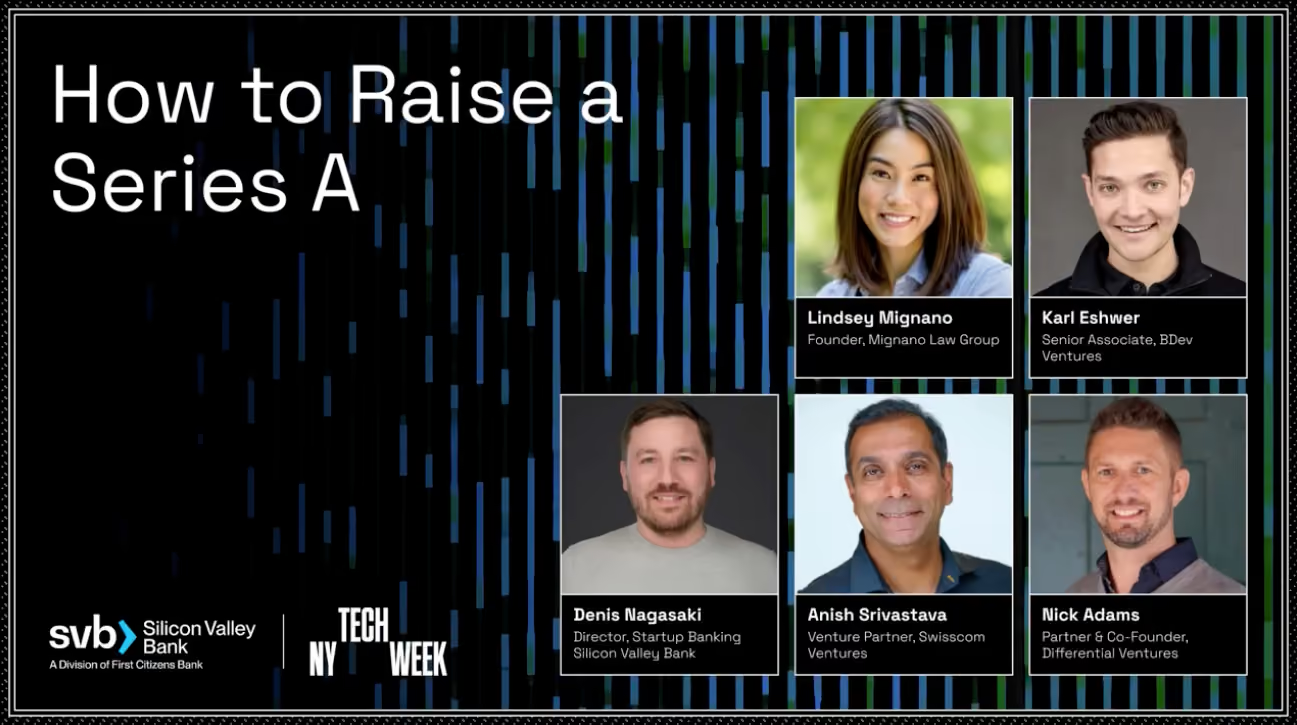

The fastest Series A rounds are often closed by founders who started the investor conversation six months before they officially kicked off a raise. At a Silicon Valley Bank panel during New York Tech Week, investors from Differential Ventures, BAV Ventures, and Swisscom Ventures laid out exactly what gets a round done fast and what quietly kills it before it ever gets going.
Every founder asking "am I ready for my Series A?" leads with ARR. The panelists were unanimous: it's a starting point, not the signal.
"Founders tend to index on like, what's the revenue number I need to be at," said Nick Adams, co-founder of Differential Ventures. "The very unsatisfying answer is it depends."
What VCs are actually evaluating is growth rate and defensibility. In application-layer AI especially, early revenue can be misleading. A company at $10M ARR can still struggle to close a Series A if growth has plateaued or comes entirely from founder-led sales. For enterprise software, Anish from Swisscom Ventures shared the efficiency benchmarks his team uses: a 1.5x burn multiple, 90% gross revenue retention, and 120%+ NRR. The bar, he noted, is roughly where Series B was five years ago.
If every deal required the founder in the room, investors see a ceiling. Carl Ashwer from BAV Ventures flagged this as a consistent pattern: "If you've gotten to a $3-5 million ARR number but it's all founder-led sales, the immediate question in my mind is: how does this scale?"
Having a sales team in place, or at least a clear plan to build one, is increasingly a Series A checkbox. The question isn't just where you are. It's how you get from $5M to $15M.
One of the clearest warnings from the panel came from startup lawyer Lindsay Mñano of Mñano Law Group. Convertible notes and SAFEs that seemed simple at pre-seed often carry terms that complicate the Series A significantly.
The most common trap: MFN provisions. If an early investor received a post-money valuation cap on a SAFE and you checked "add MFN," every subsequent SAFE investor inherited those terms automatically. That can mean unexpected dilution founders only discover when a CFO runs the proforma.
"You can model out the raise on your cap table software," Mñano said, with an explicit shoutout to Cake. "And you should."
Pro-rata rights are another one. Honoring pratas from early believers can mean taking in more capital than you actually need at Series A just to accommodate everyone owed a follow-on. Understanding how your SAFEs and convertible notes stack before you're in the room with a lead investor is the work that prevents surprises.
Lindsay Mñano gave a striking figure from her firm's docket: roughly one-third of early-stage startups face a co-founder split. That alone doesn't kill a company. What kills it is missing documentation.
If a departing co-founder never signed an IP assignment, investors will find it in diligence. The checklist is short: every founder, employee, and contractor should have signed a CIIA or PIIA from the start. Online incorporation services typically provide the form. Not using it is one of the most preventable deal risks in early-stage funding, and it shows up alongside everything else in an investor-ready cap table review.
If you're planning a Series A in twelve months, the panelists aligned on timing: start conversations now. Not to pitch, but to build a relationship that means your IC case is already half-written when you're ready.
"If you want to close it in one month, you should have met [the investor] six to nine months ago," Mñano said.
The best warm intro, multiple panelists agreed, comes from a high-performing founder in that investor's portfolio. Not your lawyer, not your banker. A founder who can say "I know this team, and here's why they execute." Cold outreach still works, but the relationship is what turns a three-month process into four weeks.
For another set of perspectives from this event series, the Boston Tech Week Series A panel covered similar ground with a different VC cohort.
The speed round closed on a deceptively simple theme. "Knowing your numbers cold on what gross margin looks like gets overlooked a lot," said Anish. "When a founder says, 'let me get back to you on ARR,' something breaks in that conversation."
Obsession with the customer should mean obsession with the business. Growth rate, burn multiple, retention. If you can't quote them off the top of your head, that's a signal to investors about how closely you're running the company.
Nick Adams closed with a note for first-time founders that's worth taking to heart: "Just get started. It's not going to be perfect and it never will be. Know enough about where the big potholes are to not step in those."
The founders who close Series A rounds quickly are the ones who know exactly what their cap table looks like after the round before they sign anything. That means modeling dilution, stress-testing SAFE conversion, and knowing where the ownership lands across every scenario.
Model your next raise on Cake Equity and go into your Series A with the numbers already in hand. Get started free.