

Most founders sign their RSA paperwork on day one and move on. There's a company to build, a product to ship, a team to hire. The equity stuff can wait.
Then a co-founder leaves 14 months in. Or a key early employee walks out before their cliff. Suddenly the details buried in that grant agreement matter — and founders who didn't read the fine print are scrambling.
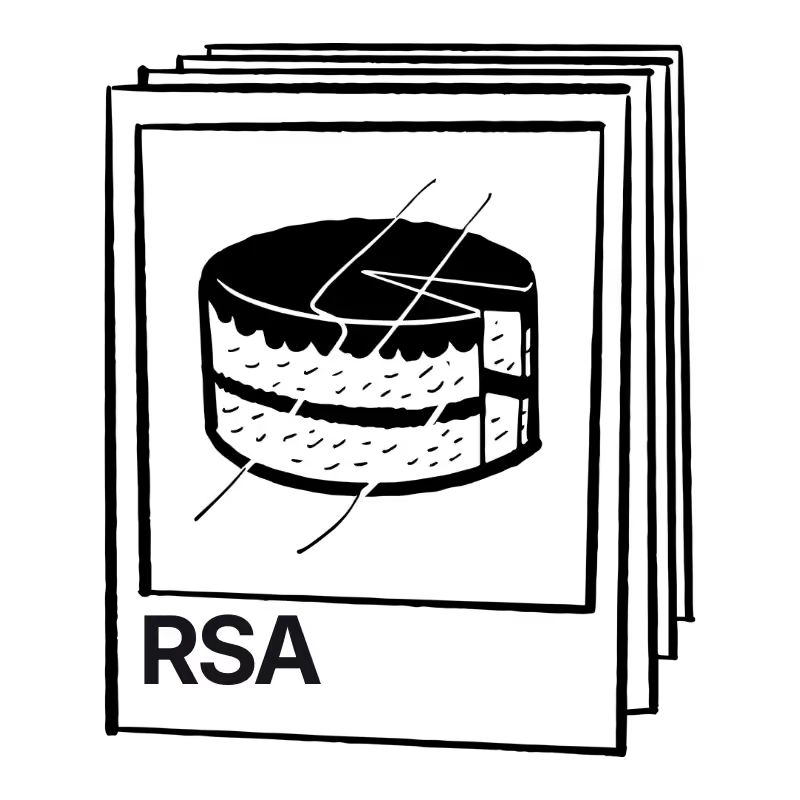
Restricted Stock Awards (RSAs) are one of the most powerful equity tools available to early-stage startups. They're also routinely misunderstood. Most of the confusion comes from conflating RSAs with RSUs or stock options — three instruments that sound similar but work very differently.
This guide covers what RSAs are, how they differ from other equity types, how vesting works, what the 83(b) election actually means for your tax bill, and when RSAs are the right tool for the job.
What are Restricted Stock Awards?
Restricted stock awards are actual shares, not a promise of shares.
An RSA is a direct grant of company stock. The recipient owns real shares from the moment the grant is issued — not a right to buy shares later, not a promise that shares will arrive someday.
What makes them "restricted" is a repurchase right the company holds on unvested shares. If the recipient leaves before their shares fully vest, the company can buy back the unvested portion at the nominal price originally paid. At the early stage, that price is effectively zero.
RSAs typically involve a near-zero purchase price because at incorporation, a startup's fair market value is close to nothing. No products, no revenue, no formal valuation. A founder or early employee can receive hundreds of thousands of shares for a few dollars total.
One underappreciated benefit: RSA recipients usually get voting rights on unvested shares. That's not true for stock options or RSUs, where voting rights only come after exercise or settlement. For co-founders especially, that distinction matters from day one.
RSA vs RSU vs stock options
The three most common equity instruments in early-stage startups each solve a different problem. Using the wrong one at the wrong stage creates real headaches.
Restricted Stock Awards
Restricted stock awards (RSAs) transfer ownership immediately. Recipients get shares at grant, subject to vesting restrictions. They work best at or near incorporation, when fair market value is still near zero and the tax cost of receiving shares is minimal.
Restricted Stock Units
Restricted stock units (RSUs) are a promise of shares delivered at a future triggering event, typically an IPO or acquisition. No shares change hands at grant. RSUs are common at later-stage private companies and public companies where a liquidity event is on the horizon.
Stock Options
Stock options (NSO, ISO) give recipients the right to purchase shares at a fixed strike price in the future. Ownership doesn't transfer until the option is exercised. Options become the practical choice once a 409A valuation has set a real FMV for the company's stock.
Your company's stage usually determines which tool fits. For example: At incorporation, RSAs. After a priced round and 409A, Stock options. Approaching an IPO or acquisition, RSUs.
There's a practical reason for this progression. Once a 409A gives your stock real value — say, $1.00 per share — issuing an RSA becomes expensive for recipients fast. A 100,000-share grant would require a $100,000 purchase on day one. Stock options sidestep that problem entirely, since recipients only pay at exercise, if they choose to exercise at all.
Vesting schedules determine when RSA shares are truly yours
Vesting for RSAs works differently than vesting for options, and the distinction is worth getting right.
With stock options, vesting determines when you can exercise — when you can buy shares. With RSAs, you already own the shares. Vesting instead controls when the company's repurchase right expires. Each time a tranche vests, the company loses the right to claw back those shares if the recipient leaves.
The most common structure is a four-year schedule with a one-year cliff. Nothing vests for the first 12 months. At the one-year mark, 25% of the grant vests at once. The remaining 75% vests monthly or quarterly over the following three years.
That cliff protects the company from someone collecting equity and walking out before contributing meaningfully. We see this structure on Cake across the vast majority of RSA grants — especially for co-founders and founding team members.
Vesting start dates are worth getting specific about. For founders, the start date often backdates to incorporation, or even earlier to when meaningful work on the company began. That's intentional — a co-founder who spent six months building a product before the company was formally incorporated shouldn't have their clock reset to zero on the day paperwork got filed.
Performance-based vesting is possible with RSAs but uncommon. Time-based vesting is the standard. It's simple, predictable, and straightforward to administer — and simplicity matters when you're managing a cap table with five moving parts and a product launch on the horizon.
For a detailed breakdown of how vesting schedules work across equity types, see our vesting schedule guide.
Why filing the 83(b) election is important for RSA recipients
File the 83(b) election within 30 days of receiving an RSA grant. Full stop.
Here's what's at stake. The IRS default rule taxes RSA shares as ordinary income each time a vesting event occurs. If your startup grows from near-zero to a $10M valuation over four years, every quarterly vesting event triggers a taxable income assessment at whatever the fair market value is at that moment. Ordinary income rates reach up to 37% at the federal level.
The 83(b) election changes the timing of that tax event. Filing tells the IRS: tax me now, at the current fair market value, not later at each vesting event. For a founder receiving RSAs at incorporation, that fair market value is effectively zero. The upfront tax bill is minimal — sometimes a few dollars. Future appreciation then qualifies as a capital gain when shares are eventually sold, taxed at long-term capital gains rates (maximum 20% federal) rather than ordinary income rates.
The math is compelling. The window is not forgiving.
You have 30 calendar days from the grant date. Not business days. Not 30 days from when you received the paperwork. The clock starts the day stock is transferred to you. The IRS grants no extensions — not for illness, not for administrative delays, not for "I didn't know about it." Missing the window means the election is permanently void.
In November 2024, the IRS introduced Form 15620, a dedicated Section 83(b) election form that accepts electronic filing. That's a genuine improvement over the previous process of drafting a custom letter and mailing it to the correct IRS service center. Electronic submission also provides immediate confirmation of receipt.
One risk worth flagging clearly: if you file an 83(b) and your unvested shares are later forfeited — because you leave the company before they vest — you don't get a refund on taxes paid at grant. For a founder receiving shares at near-zero value, that exposure is minimal. For an employee joining a more mature startup at a higher FMV, the calculation deserves more careful consideration.
For the full picture on filing mechanics, tax scenarios, and what to include in the form, see our 83(b) election guide. For the authoritative source on the election itself, the IRS publishes Form 15620 with instructions.
[Visual suggestion: Two-column tax comparison — "Without 83(b)" vs "With 83(b)" — showing tax triggered at each vesting event vs. tax paid once at grant, illustrated with a simple dollar example across a 4-year growth scenario]

Manage your RSA grants with confidence using Cake Equity
Issue RSA grants directly from your cap table, set vesting schedules, and track ownership in real time — all in one place.
Every RSA grant on Cake includes:
- Grant issuance from your cap table. Issue RSAs to founders, early employees, and advisors without spreadsheets or manual share calculations.
- Vesting schedule management. Configure any combination of cliff and ongoing vesting, and track every tranche automatically as time passes.
- Live ownership tracking. Every grant is reflected immediately in your cap table, so you always know exactly who owns what and how much has vested
- Shareholder portal. Grant recipients can view their equity, vesting progress, and grant documents in one place
Know more about how Cake manages restricted stock.
What happens to RSAs when someone leaves the company
When an RSA recipient leaves, one question determines the outcome: which shares have vested?
Vested shares belong to the departing person. The company's repurchase right has already expired on those shares — the employee or founder walks away with full ownership. Unvested shares are a different story. The company typically repurchases them at the original purchase price, which for an early-stage RSA is usually a fraction of a cent per share.
This is what vesting is designed to do. A co-founder who leaves after 18 months — just past the one-year cliff — keeps 25% of their grant and forfeits the rest. The company recaptures those unvested shares and can reissue them to a replacement hire, into an option pool, or back to remaining founders.
Two things commonly addressed in RSA agreements: acceleration clauses and forfeiture tax risk:
- On acceleration: a single-trigger clause vests some or all unvested shares automatically upon acquisition. A double-trigger clause requires two events — typically acquisition plus termination — before acceleration kicks in. Both are common in founder RSA agreements, and having a clear position on this before a term sheet arrives tends to make negotiations smoother.
- On forfeiture tax risk: if an 83(b) election was filed and shares are subsequently forfeited unvested, taxes paid at grant are not refunded. For founders who paid near-zero tax at incorporation, the practical exposure is small. For employees who joined at a higher FMV and paid real money at grant, this is worth understanding before signing.
On Cake, departures and repurchases are tracked directly on the cap table. Ownership stays accurate and auditable without requiring manual updates every time something changes.
RSAs make the most sense before your first formal valuation
RSAs are not a one-size-fits-all equity tool. They're designed for one specific window: early enough that the company's stock is worth almost nothing.
At incorporation — or in the weeks just after — that window is open. A co-founder can receive 2,000,000 shares for $200. If an 83(b) is filed, tax is paid on near-zero value and future appreciation is treated as capital gain when shares are sold.
The window starts closing once money comes in. After a pre-seed or seed round, a 409A valuation is typically required before issuing new equity. That valuation assigns real fair market value to your common stock. A 100,000-share RSA at $1.00 per share now costs the recipient $100,000 upfront. That's not a realistic ask for most early hires.
After the first 409A, most startups transition to stock options. What we see on Cake: ISOs are common for full-time US employees, while NSOs tend to appear for contractors, advisors, and non-US recipients. Take note that the right structure depends on each company's specific setup and the guidance of their legal counsel.
In practice, RSAs are most commonly issued to co-founders at incorporation, the first one or two employees who join before any funding, and early advisors brought on before a formal valuation exists. After that, options take over.
Your questions about RSA, answered
What is a restricted stock award (RSA)?
A restricted stock award is a direct grant of company stock. The recipient owns shares immediately at grant, subject to a vesting schedule that gives the company the right to repurchase unvested shares if the recipient leaves. RSAs are most commonly issued to founders and very early employees before a formal company valuation exists.
What is the difference between an RSA and an RSU?
An RSA transfers actual shares at grant. An RSU is a promise of shares delivered at a future triggering event — typically an IPO or acquisition. RSAs are used early, when company value is near zero. RSUs are common at later-stage companies approaching a liquidity event. RSAs are eligible for the 83(b) election; RSUs are not. See our RSA vs RSU comparison for the full breakdown.
Do I need to file an 83(b) election for my RSA?
Filing is not legally required. What we typically see on Cake: founders receiving RSAs at or near incorporation almost always file, because the tax on a near-zero value grant is minimal. The right decision depends on individual circumstances — a qualified tax advisor can help assess your specific situation.
What happens to my RSA if I leave the company?
Vested shares are yours to keep. Unvested shares are typically repurchased by the company at the original purchase price — usually a nominal amount. If you filed an 83(b) election, taxes paid at grant are not refunded for forfeited unvested shares.
When should a startup use RSAs instead of stock options?
RSAs are most commonly used at or near incorporation, when fair market value is near zero. Once a 409A valuation establishes real FMV, RSAs become costly for recipients and stock options become the more common instrument. For most startups, RSAs tend to be the tool for the founding team, with options taking over from the first institutional raise onward. A startup attorney can help determine the right structure for your specific stage.
RSAs are rewarding when used correctly
They give founders and the earliest team members real ownership — not a promise, not a right to buy later — from day one. That directness aligns incentives in a way other instruments don't quite replicate.
The one sharp edge: the 83(b) window. Thirty days. No exceptions. It's the single administrative task in early-stage equity that genuinely cannot be left for later.
Many founders put it on the calendar the day the grant is issued — a small habit that avoids a costly oversight. If you're on Cake, the platform sends the alert automatically, so even if the paperwork gets buried under a product launch, the deadline doesn't disappear on you.
Getting the mechanics right at the founding stage isn't just good practice. It's how you make sure the equity you're handing out actually works the way you intend it to.
This article is designed and intended to provide general information in summary form on general topics. The material may not apply to all jurisdictions. The contents do not constitute legal, financial or tax advice. The contents is not intended to be a substitute for such advice and should not be relied upon as such. If you would like to chat with a lawyer, please get in touch and we can introduce you to one of our very friendly legal partners.